Alekos Fassianos
The Dreamers
Museum St | 43 Museum St, London, WC1A 1LY
1 April – 23 May 2026
Alekos Fassianos
Un Seigneur
1995
Acrylic on canvas
47 x 33 x 2 cm / 18.5 x 13 x 0.8 in, unframed
51.5 x 38.3 x 4 cm / 20.3 x 15.1 x 1.6 in, framed
Dans mon rêve, le plaisir perdu. (In my dream, the lost pleasure)
– Alekos Fassianos, ‘Rêve’, 1992
Herald St is delighted to announce The Dreamers, its first solo exhibition of paintings and drawings by Alekos Fassianos (b.1935, Athens; d.2022, Athens). Taking place in the gallery’s Museum St premises, it includes previously unseen works from the estate’s archive and a selection of pieces from a private Athenian collector, who was a close friend of the late artist. They span over three decades, with the earliest painting from 1970 made in the heyday of Fassianos’s extended Parisian sojourn, and a number of tableaux produced after his return to Athens in the 1990s.
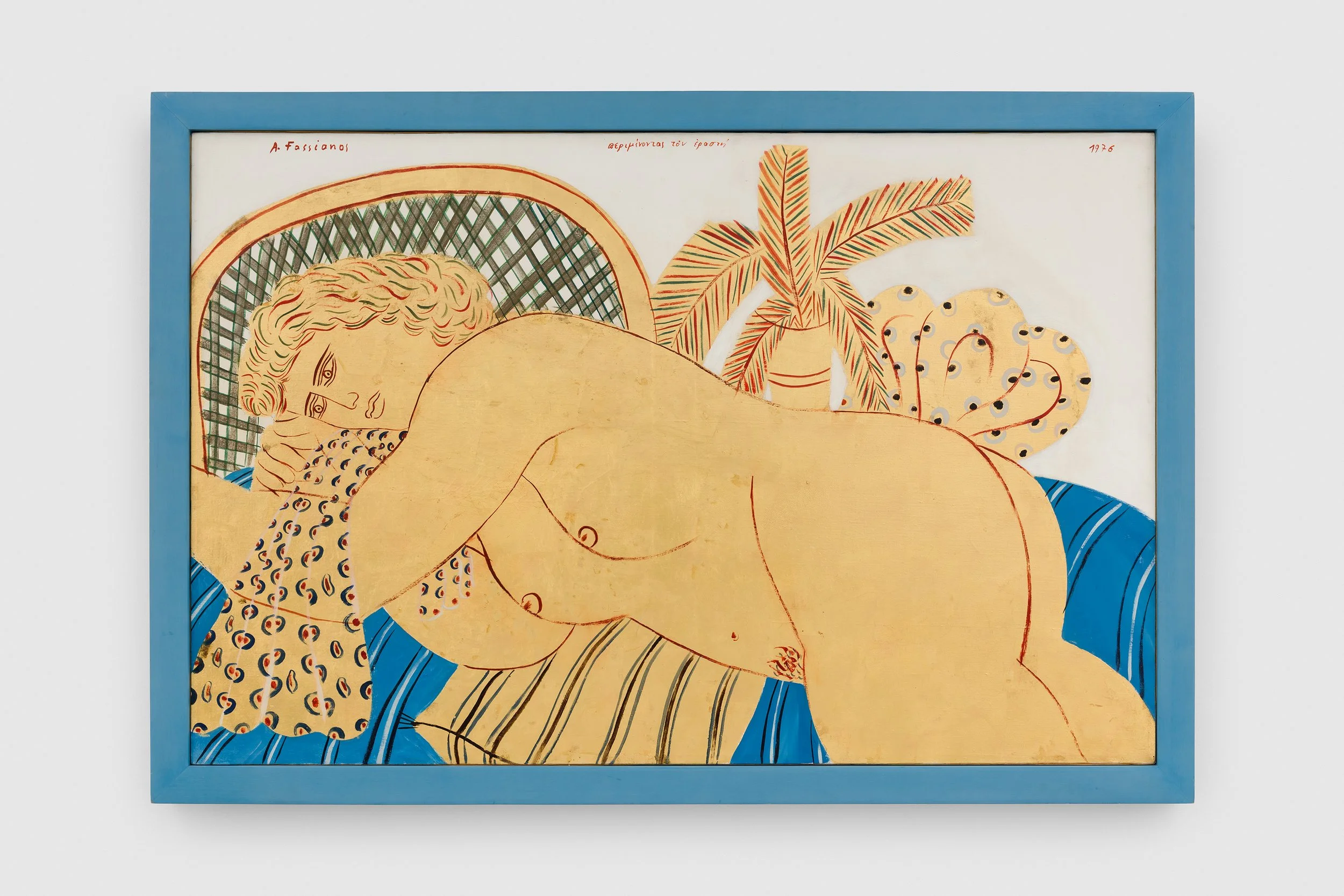
Alekos Fassianos
περιμένοντας τον εραστή (En attendant l'amant)
1976
Oil and gold leaf on canvas
65 x 99 cm / 25.6 x 39 in, unframed
73 x 107 x 4.5 cm / 28.7 x 42.1 x 1.8 in, framed
HS21-AF9332P
The exhibition’s title nods to Gilbert Adair’s cult novel, adapted for film by Bernardo Bertolucci, which follows a pack of teenagers navigating the sensual and revolutionary spring of 1968 in Paris with louche precocity and wild abandon. It was during this heady decade that Fassianos first studied in and eventually moved to the French capital, escaping the rise of dictatorship in his native Greece and immersing himself in the literati café culture and pervasive air of freedom. Befriending architects, authors, philosophers, and poets, the artist developed a distinctive style which marries the divinities and mythologies of his home country with his new, enthralling metropolitan existence. Androgynous men and women en déshabillé, angels in bedrooms, windows looking out onto skyscrapers, and blowsy cyclists with scarves trailing in the wind were rendered in shapely planes of white, red, ultramarine, dusty pink, ochre, and green. In the late 1970s, Fassianos entered a ‘Byzantine’ era, adding volume to previously flat figures and incorporating gold and silver leaf to create tableaux reminiscent of the icons he knew so well from Orthodox churches.
The young artist soon attracted the attention of gallerists du jour including Paul Facchetti and Alexandre Iolas, exhibiting alongside Giorgio de Chirico, René Magritte, Georges Mathieu, Martial Raysse, Jean Paul Riopelle and Niki de Saint Phalle. His works travelled to Tokyo, Sāo Paulo, Beirut, Istanbul, and across Europe. In 1972 he represented Greece in the Venice Biennale, and went on to be awarded Officier de la Légion d’Honneur and Commandeur de l’Ordre des Arts et des Lettres in France. In addition to his paintings, Fassianos’s irrepressible and polymathic output included architecture, costume and stage sets for the National Theatre of Athens, furniture design, book illustrations and editions, playgrounds and toys, and his own lyrical and evocative poetry. Moving between Paris, Athens, and the island of Kea, he built and inhabited his own world, one that became immediately recognisable and nationally – and internationally – beloved.
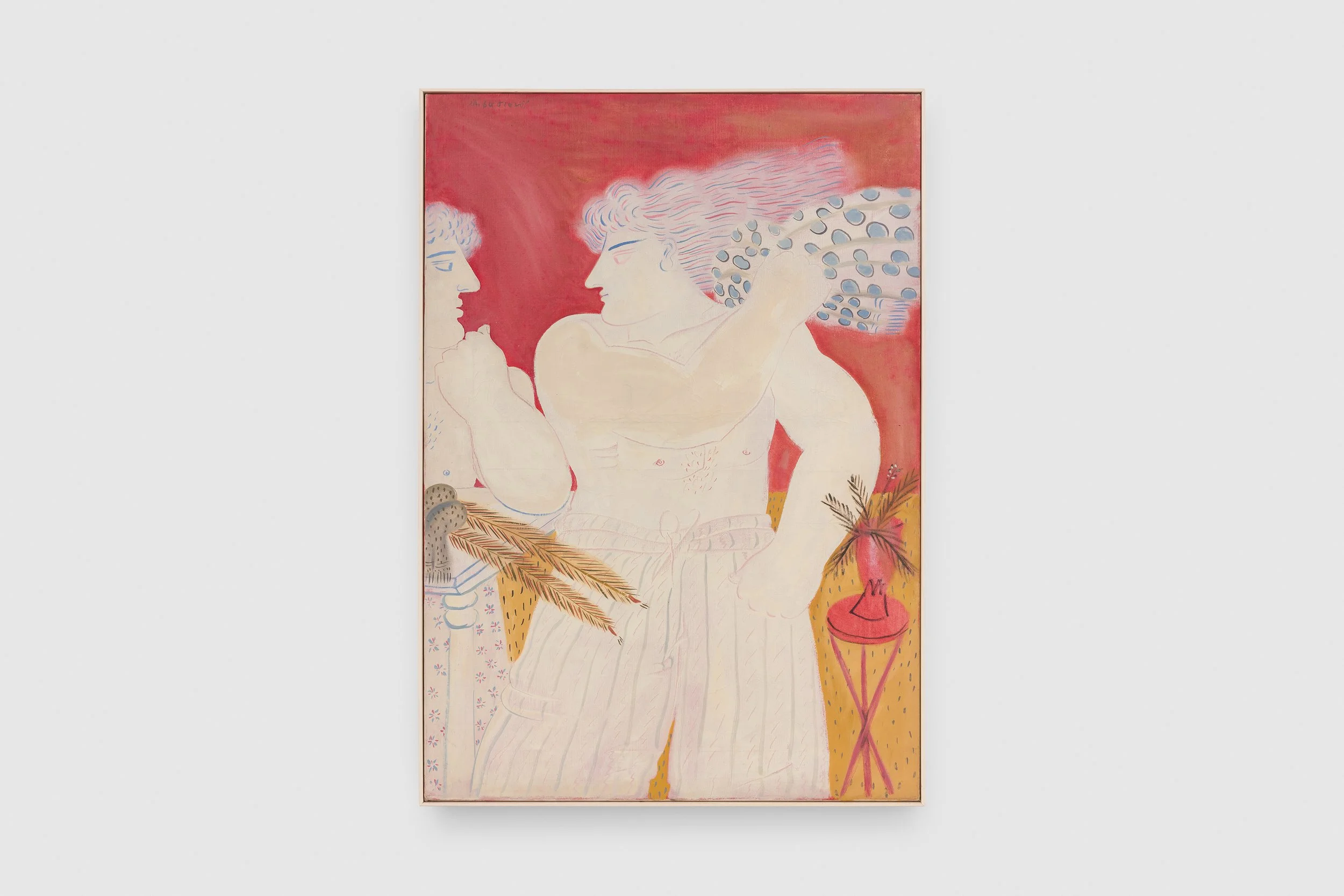
Alekos Fassianos
Sans titre
1987
Oil on canvas
102.5 x 72 x 3.5 cm / 40.4 x 28.3 x 1.4 in
HS21-AF9333P
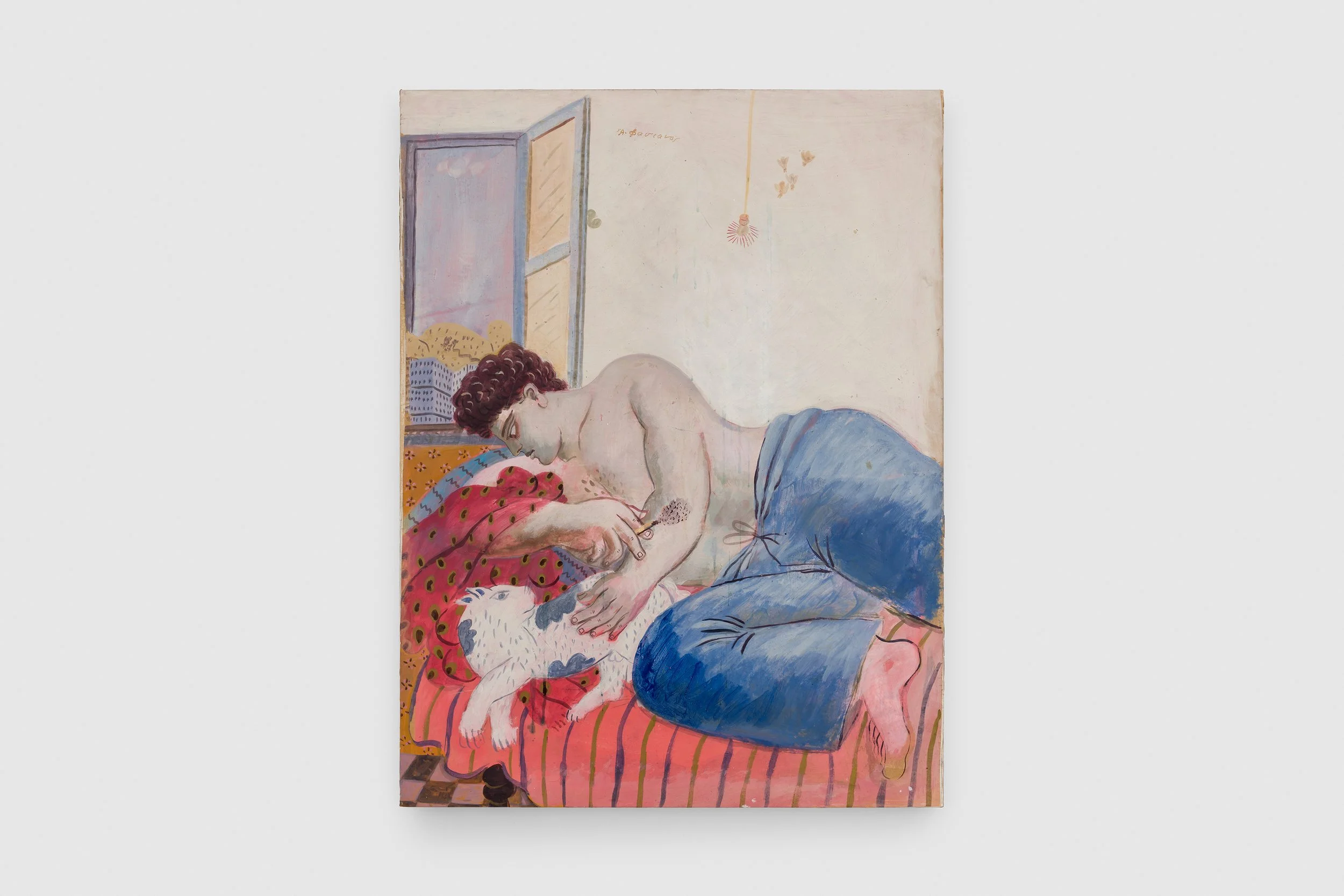
Alekos Fassianos
Sans titre
1985-1989
Acrylic on paper laid down on canvas
95.5 x 72 x 2.2 cm / 37.6 x 28.3 x 0.9 in, unframed
HS21-AF9334P
For the many decades Fassianos embraced life in France, he always kept Greece close to his heart – as he would say, like a bee he held his honey, his home, wherever he went. His paintings carry the warmth of the Mediterranean and exude sensual and sensorial pleasures: the sweetness of summer fruits, the downy fur of a cat, the fragrance of a rose, the coo of a dove, the depth of a night sky. The artist developed his own vernacular, filling his paintings with repeating symbols such as blades of wheat to represent life, rebirth, and nature; scarves and bicycles for the debonaire liberté of Paris; birds as a sort of signature, as his name translates to ‘pheasant’ in Greek; and mirrors as reflections of the self, which never quite match the gazer. Many of the paintings on view evoke the containment of a room, small spaces of intimacy, rumination, and voyeurism within the cacophony of a city, with layers of other lives wafting through the windows. These vignettes are vivid and languorous, their Adonisian figures recumbent and windswept and in a trance-like state of soft contemplation, perhaps dreaming about a lover or their home. Mythologising the quotidian, Fassianos reveals mysticism in the everyday by imbuing his works with light, humour, and insouciance, as well as longing, melancholy, and deep introspection.
– Text by Émilie Streiff
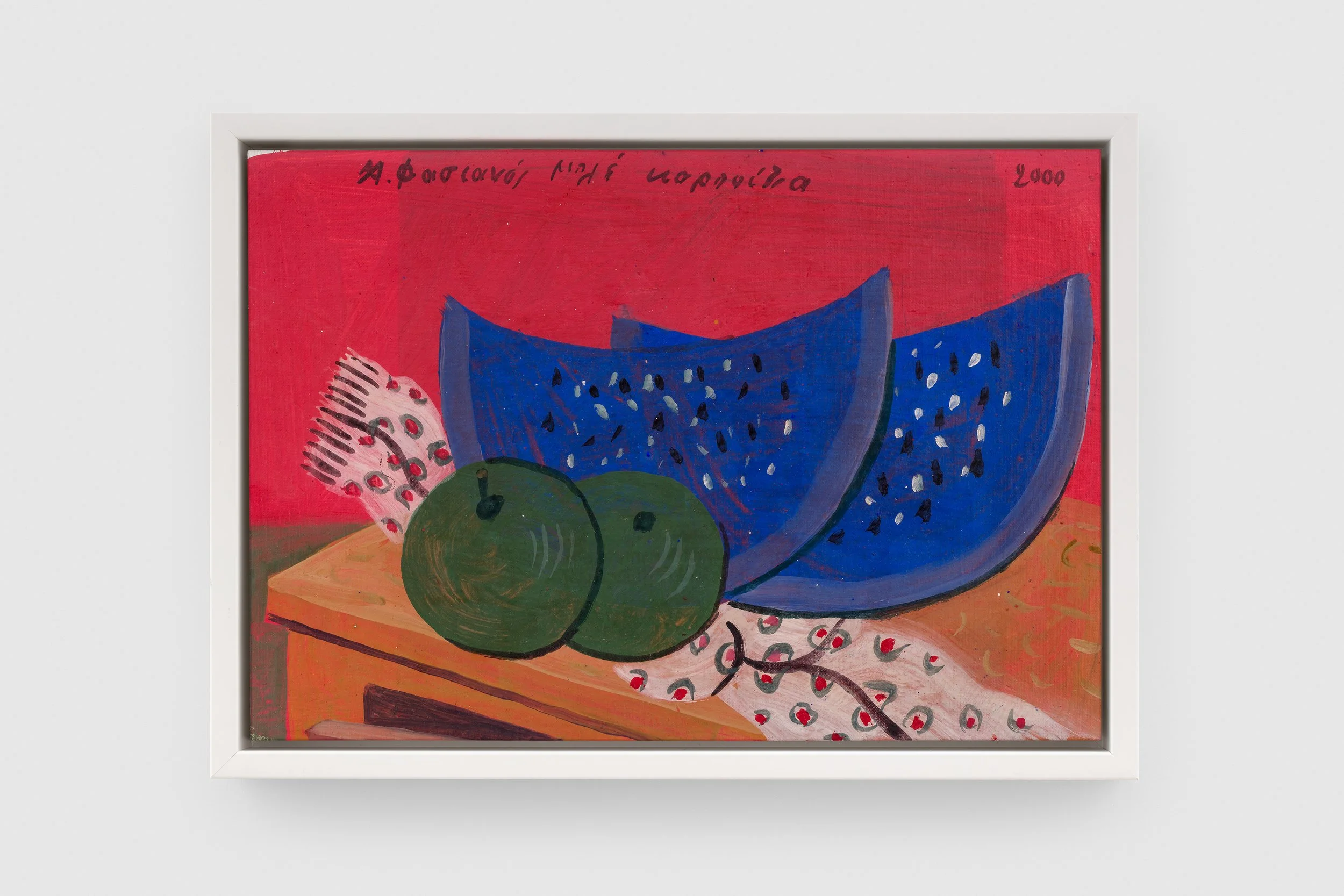
Alekos Fassianos
Μπλε καρπούζια (Blue watermelons)
2000
Oil on canvas
40 x 30 cm / 15.7 x 11.8 in
HS21-AF9337P